
in partnership with

Congratulations on passing the second level, it's time to move for the critical range of diagnostic imaging. This level tests whether your monitor meets the 400cd/m2 brightness standard, which is required for diagnostic monitors used by radiologists and medical professionals for making accurate, life-saving diagnoses.


The risk of stopping at this level
If your monitor can't pass this level, it may not be optimized for the most advanced diagnostic requirements, such as mammography, oncology imaging, or high-contrast grayscale interpretation.
Here's why 400 cd/m2 is the minimum for diagnostic monitors, but not the highest standard
Limited DICOM Compliance without calibration
Some monitors may reach this brightness level but fail to meet the grayscale standard.
Subtle Diagnostic details may still be missed
While sufficient for general diagnostic imaging, conditions like microcalcifications in mammograms or faint hairline fractures might still be difficult to detect.
No Built-in Brightness stabilization
Unlike radiology-grade monitors, many standard screens at this brightness level don't auto-adjust brightness over time, leading to inconsistent image quality.
WHAT IT MEANS TO PASS THIS LEVEL
If you can still see the symbol, your monitor is capable of displaying medical images with moderate brightness and grayscale accuracy. It may be suitable for clinical review, but it might not meet the gold standard for diagnostic imaging.
This level represents the brightness found in:
Medical-Grade Diagnostic Monitors
Used by radiologists and designed for precise grayscale accuracy to detect fine details in MRIs, CT scans, and X-rays.
High-Brightness Professional Displays
Some high-end professional monitors used in medical imaging, CAD, and creative industries reach this level but may not be DICOM-calibrated.
New Clinical Review Monitor
Some modern clinical review monitors approach this brightness level but may still lack full DICOM compliance.
CAN’T SEE THE SYMBOL?
Your monitor might not be suitable for medical imaging. Don’t risk missing critical details in your diagnostics. Get a free Consultation Today! Our experts can help you find the right medical-grade monitor for accurate imaging and compliance with DICOM standards.
Get Free Consultation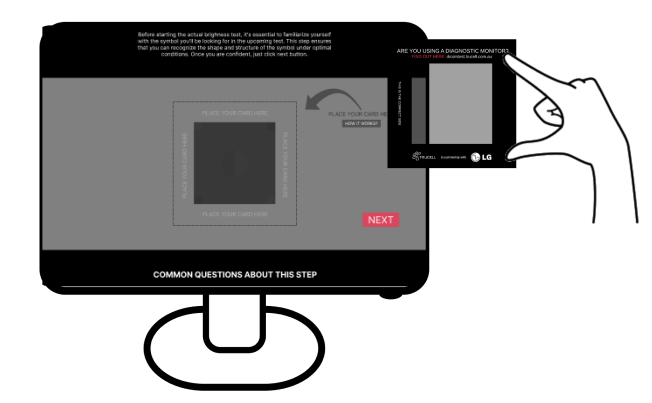




Disclaimer
This test is non-clinical and does not replace a professional calibration or regulatory assessment. Always follow institutional guidelines and manufacturer recommendations for diagnostic displays.